
Does Perineal Massage Actually Work? Here's What the Research Really Says
Right. Let's talk about something that comes up in almost every pregnancy yoga class at some point — and that most of us have quietly googled at 11pm with a slightly uncertain look on our faces.
Perineal massage.
Your midwife may have mentioned it. Your NCT pack may have a leaflet about it. And you may have got as far as reading the instructions, raised an eyebrow and then thought — do I actually have to do this? And does it even work?
I love this question because the honest answer is: yes, kind of — and the detail really matters. So let's look at what the science actually says, in plain English, so you can make a genuinely informed choice.
What is perineal massage?
Your perineum is the area of tissue between your vagina and your back passage. During a vaginal birth, this area needs to stretch — a lot. Perineal massage is a way of gently preparing that tissue in the weeks before your birth, helping it become more supple and elastic.
It involves using your thumbs (or your partner's) to apply gentle downward pressure inside the vaginal opening and slowly stretch the tissue in a U-shaped movement. It's not painful — it should feel more like a mild stretching sensation. And you only need to do it for around 5–10 minutes at a time.
The research suggests starting around 35 weeks, roughly once or twice a week. That's it. No need to make it a daily ritual.
What does the evidence say?
The Cochrane Review on antenatal perineal massage — one of the most thorough and reliable sources of evidence in medicine — looked at nearly 2,500 women across four trials. Here's what they found.
Women who practised perineal massage were:
9% less likely to need suturing after birth — that's roughly one in every 15 women avoiding stitches altogether.
16% less likely to have an episiotomy — the surgical cut sometimes made to widen the vaginal opening.
More likely to report less perineal pain at three months postpartum — which matters enormously when you're trying to recover, feed a baby and feel like yourself again.
And the sweet spot for frequency? Once or twice a week. Women who massaged more often — over 3.5 times per week — actually saw no significant reduction at all. More is genuinely not more in this case. Just a gentle, consistent practice.
The important bit most people miss
Here's the nuance I really want you to have — because most summaries of this research skip over it.
The reduction in trauma was almost entirely driven by fewer episiotomies. There was no statistically significant reduction in spontaneous tears — the ones that just happen as your baby comes through.
So perineal massage is not a guarantee against tearing. What it does seem to do is reduce the likelihood of being cut — and reduce ongoing discomfort once your baby is here. That's still really meaningful. But it's worth going in with realistic expectations rather than feeling like you've failed if you do tear.
Also worth knowing: the benefits were clearest for women having their first vaginal birth. If you've given birth vaginally before, the reduction in physical trauma was less significant — but the reduction in postnatal pain was still real. So it's still worth considering whatever your birth history.
So should you do it?
That is completely your call — and we mean that. At LushTums we're big believers in giving you the information and then trusting you to make the right decision for yourself. Nobody should be adding things to your already-long pregnancy to-do list without a good reason.
But if you're looking for a simple, low-effort practice that has genuine evidence behind it and might reduce your chances of an episiotomy and leave you more comfortable after birth — this is worth knowing about.
A few practical tips if you want to give it a go:
Start around 35 weeks
Aim for once or twice a week — no need for more
Use a natural oil — sweet almond or coconut oil work well
Try it after a warm bath when everything is more relaxed
Ask your midwife to show you the technique if you're unsure — that's exactly what they're there for
How pregnancy yoga fits in
One of the things we do in every LushTums pregnancy yoga class is build awareness of the pelvic floor and perineal area — learning to both strengthen and release, which is just as important as each other. Perineal massage sits really naturally alongside this work.
The ability to consciously soften and release the pelvic floor — which we practise week after week in class — is one of the most useful skills you can bring to your birth. Combine that with a well-prepared, supple perineum and you're giving yourself a genuinely solid foundation.
If you're not already coming to a LushTums pregnancy yoga class, we'd love to welcome you. We have teachers across the UK offering in-person classes — find your nearest one here.
And if you're a yoga teacher reading this who wants to be able to share this kind of evidence-based guidance with your own students, you can find out about training with us at teachpregnancyyoga.com.
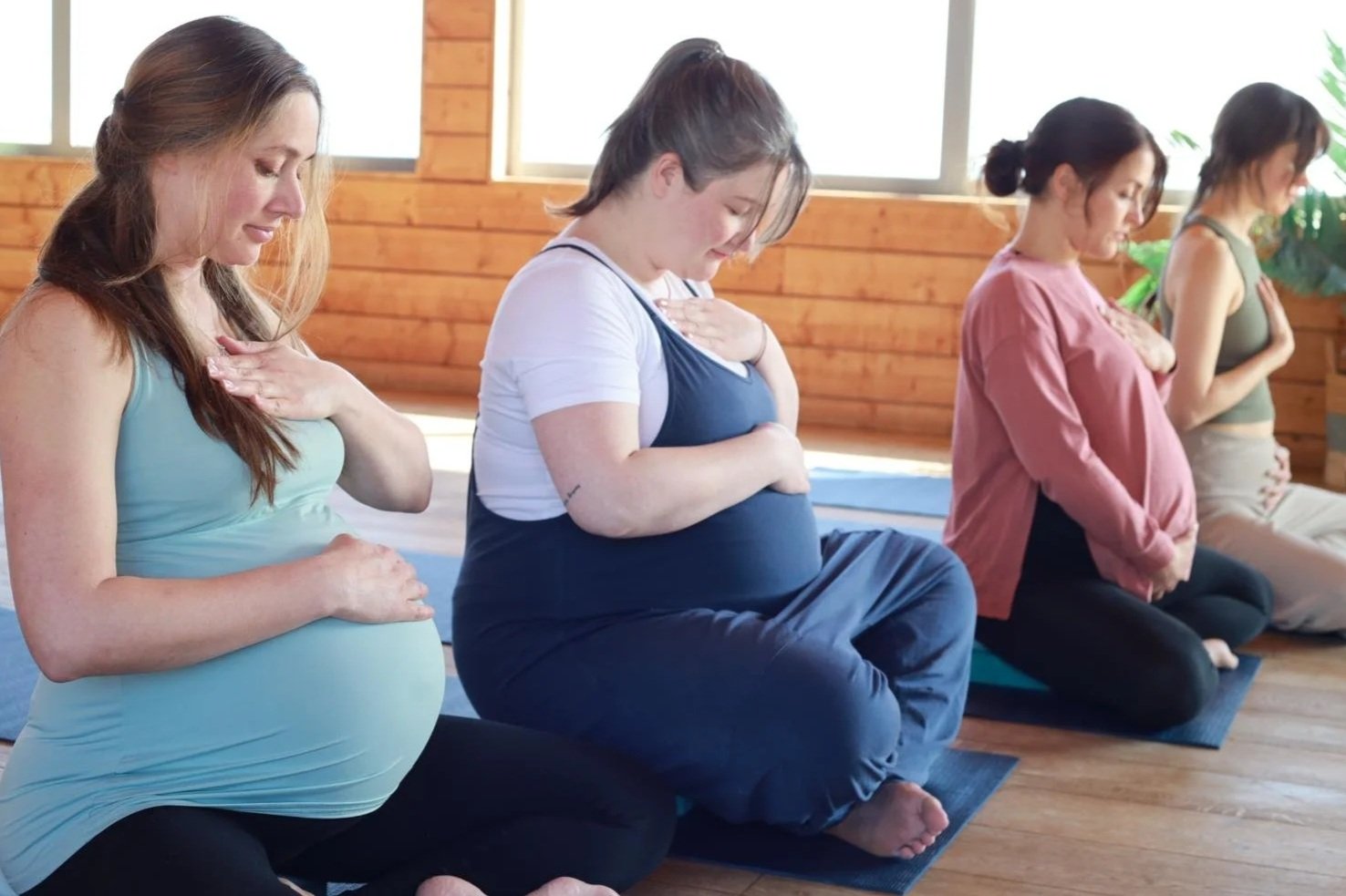
Women at Pregnancy Yoga connecting with their bodies and their babies
Clare Maddalena is the founder of LushTums — the UK's leading pregnancy and postnatal yoga company — and a Senior Yoga Teacher, Doula and Antenatal Educator with nearly twenty years of experience supporting women through pregnancy and birth.